




Home Anwendungsbeispiele Charging station infrastructure
Intelligent and economical charging stations
The electrification of fleets and operating processes is becoming increasingly important. Energy suppliers, companies with vehicle fleets, filling station operators, retailers, local authorities etc., but also smaller companies, are faced with the challenge of setting up a reliable and efficient charging infrastructure.
Why charging stations and battery storage are crucial
Charging stations are more than just charging points for electric vehicles. They form the backbone of sustainable and cost-effective electric mobility. High-power charging stations (HPC), in particular, with charging capacities of 400 kW or more, enable fast charging times and ensure high availability in commercial fleets and public charging parks.
Battery storage systems optimally complement the charging infrastructure by absorbing peak loads, optimizing the self-consumption of self-generated solar power, or buffering low grid connection capacity, thereby helping to avoid costly grid connection upgrades. Thanks to battery storage, the charging infrastructure can operate reliably even with limited grid connection capacity.
What types of charging stations are there?
- AC charging stations (alternating current): Ideal for the workplace and home use, with charging power up to 22 kW
- DC charging stations (direct current): Perfect for commercial fleets and public charging parks with charging capacities ranging from 50 to 100 kW
- HPC charging stations (direct current, High Power Charging): Enable ultra-fast charging at up to 400 kW or more, ideal for electric trucks and fast-charging stations.
Legal requirements and obligations for charging stations
Starting in 2025, commercial buildings with more than 20 parking spaces will be required to provide at least one charging station (GEIG). This applies, among others, to employers, project developers, municipalities, and all operators of large parking areas. Not only must charging points be installed, but their energy supply must also be managed intelligently and sustainably.
Overcoming Challenges with Grid Connection
The growing number of charging points—especially fast-charging points—places high demands on grid connection capacity. Often, the existing grid connection is insufficient to charge multiple vehicles simultaneously at high power. Expanding grid connections is expensive, time-consuming, and often involves supply bottlenecks for relevant components, such as transformer stations.
Benefits for Businesses When Installing Charging Stations
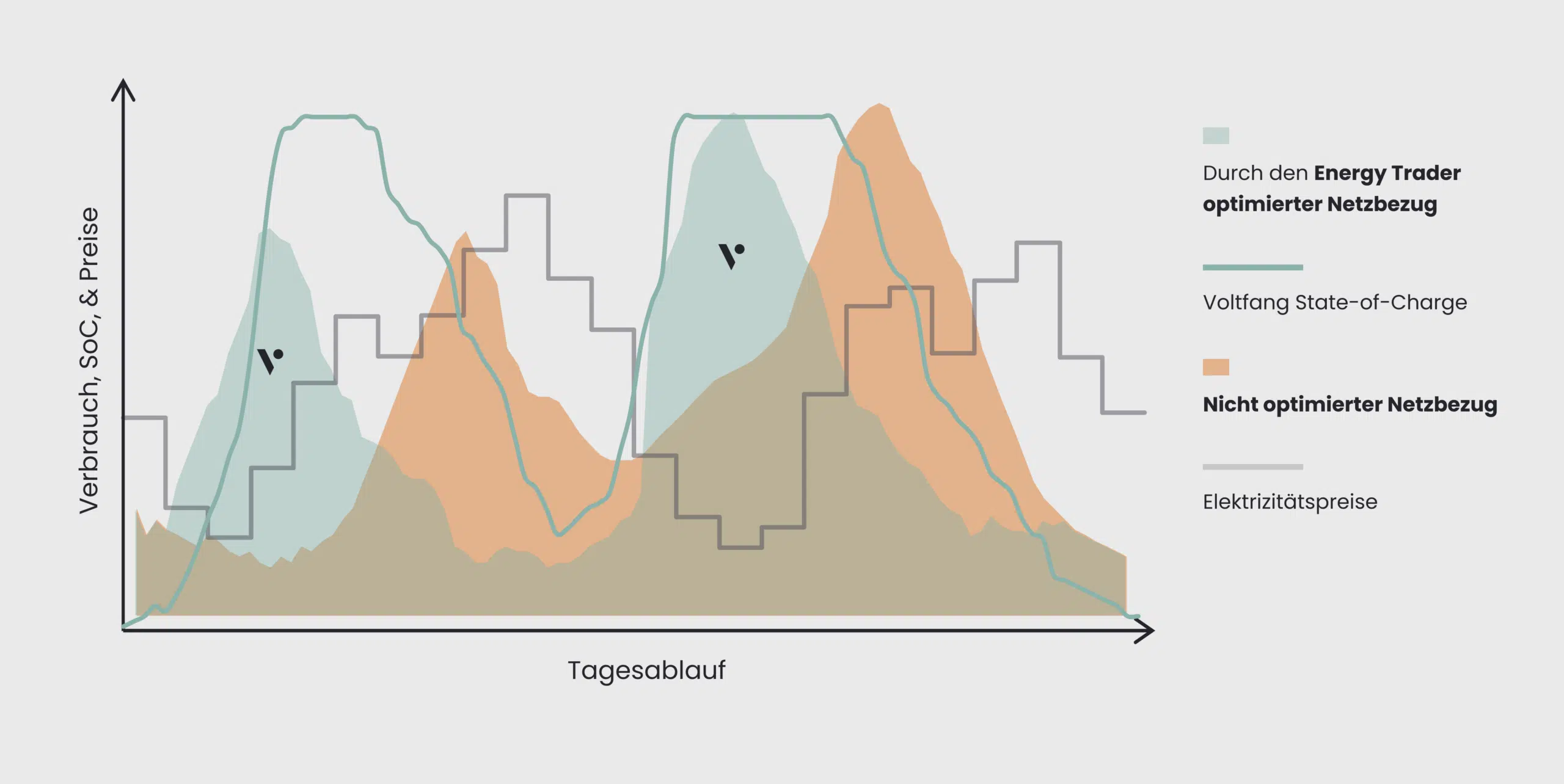
Voltfang’s battery storage systems act as buffers and enable smart load management. They reduce grid connection costs, prevent load spikes, and ensure cost-effective use of the charging infrastructure. This allows businesses to start operating charging stations more quickly and generate additional revenue.
References for charging station infrastructure
Our high-performance green battery storage systems are specifically designed for yourapplications to ensure an optimal solution. With our expertise and flexibility, we are able to master even complex challenges and provide you a high level of satisfaction.
Further use cases for increasing energy efficiency
Every company has unique power supply needs. Depending on the circumstances, one or more use cases for commercial energy storage systems may apply. Our team of experts can help you identify the right use cases and tailor them to your specific datato ensure optimal energy efficiency.
FAQs – Planning and implementing the charging infrastructure
The number of charging points depends on the size of the fleet, the daily routes and the availability of charging times. For fleets with many vehicles that are charged during the day, it makes sense to have more charging points with a higher output. For employee charging stations, individual AC charging points with up to 22 kW are often sufficient. Fast charging points (DC/HPC) are useful if vehicles need to be charged quickly at short notice.
AC charging is suitable for longer downtimes (e.g. at night or during working hours).
DC fast charging is required for fleets with a high degree of utilization or short-term charging.
HPC stations offer maximum power for e-trucks or fast-charging parks.
Charging points should be installed where vehicles are parked for long periods of time (e.g. company premises, employee or customer parking lots).
- Hardware: Charging Stations
- Installation: Civil engineering and electrical work
- Grid connection
- Battery storage: Investment depends on capacity and technology
- Electricity consumption: Depends on charging volume; varies by rate plan
- Maintenance: Regular inspections, repairs, software updates (approx. 5–10% of the investment costs per year)
- Software Licenses: The costs for Voltfang’s energy management system are already included
Yes, there are funding programs at federal, state and municipal level, e.g. from the Federal Ministry for Digital and Transport (BMVI) or KfW funding. Regional programs also support the expansion of charging infrastructure.
Profitability results from investment costs, ongoing operating costs and income (e.g. electricity sales, state subsidies). Factors include charging volume, electricity tariffs and possible grid fee savings through load management. Voltfang offers an individual profitability analysis for each individual case.
Load management systems control the charging power dynamically so that the grid capacity is used optimally without generating peaks. Battery storage systems from Voltfang with intelligent control reduce grid loads and costs.
The charging infrastructure is connected to either the low-voltage or medium-voltage grid, depending on the charging capacity and location. Grid connections must be professionally planned and approved by grid operators.
- IEC 61851 (Charging Protocols)
- ISO 15118 (Vehicle-to-Charging Station Communication)
- OCPP (Open Communication Protocol for Charging Stations
- Security and Billing Standards (e.g., Charging Station Regulation, LSV)
Voltfang’s energy management system controls user administration, load control, billing, monitoring and remote maintenance.
Intelligent systems such as Volfang’s energy management system feature remote monitoring that detects and reports faults at an early stage. Fast maintenance, replacement devices or service teams prevent downtime.
- Building permit (in many cases, no permit is required; varies by region)
- Permits for special use of public spaces
- Grid connection permit from the grid operator
Yes, since 2025, commercially used buildings with more than 20 parking spaces must provide at least one charging point. In addition, requirements regarding technical equipment and accessibility must be met.