

How large does a PV system need to be for a commercial storage system?
Author: Julie Vandegaar
Reading time: 5 min
Table of contents
Combining a PV system and commercial storage
The integration of photovoltaic (PV) systems and battery storage systems into day-to-day operations is becoming increasingly important – not only to reduce energy costs, but also to make companies sustainable and future-proof. But how big does a PV system in combination with a commercial storage system and battery storage system need to be to efficiently cover a company’s energy requirements? In this article, we explain which factors play a role in planning and how you can determine the optimum size of your PV system and storage system for your business.
Good to know!
The continuous innovative strength of companies and cooperation between them has driven the battery storage market forward massively in recent years. PV systems are no longer a prerequisite for the profitable installation of a battery storage system
Planning the PV system for companies
Careful planning begins with an analysis: What is your energy requirement? At what times do peak loads occur? And how much solar power is your PV system likely to generate over the course of the year? Once these questions have been answered, the ideal size of your photovoltaic system and the commercial storage system can be determined.
This is because the electrical load profiles of businesses are as different as they are different. A food market, for example, has a high energy requirement throughout the day, while bakeries consume more electricity at night. Manufacturing companies, on the other hand, can fluctuate seasonally, and hotels have their peak demand in the evenings and at weekends.
A guide value of around 0.8 to 1.0 kWp per 1 MWh of annual consumption can be used to determine the required output of a commercial PV system. Example: A manufacturing company with an annual consumption of 500 MWh could install a PV system with around 400 to 500 kWp in order to achieve the highest possible self-consumption. A battery storage system can be useful, for example, if electricity consumption is high outside of sunshine hours or if peak loads need to be absorbed.
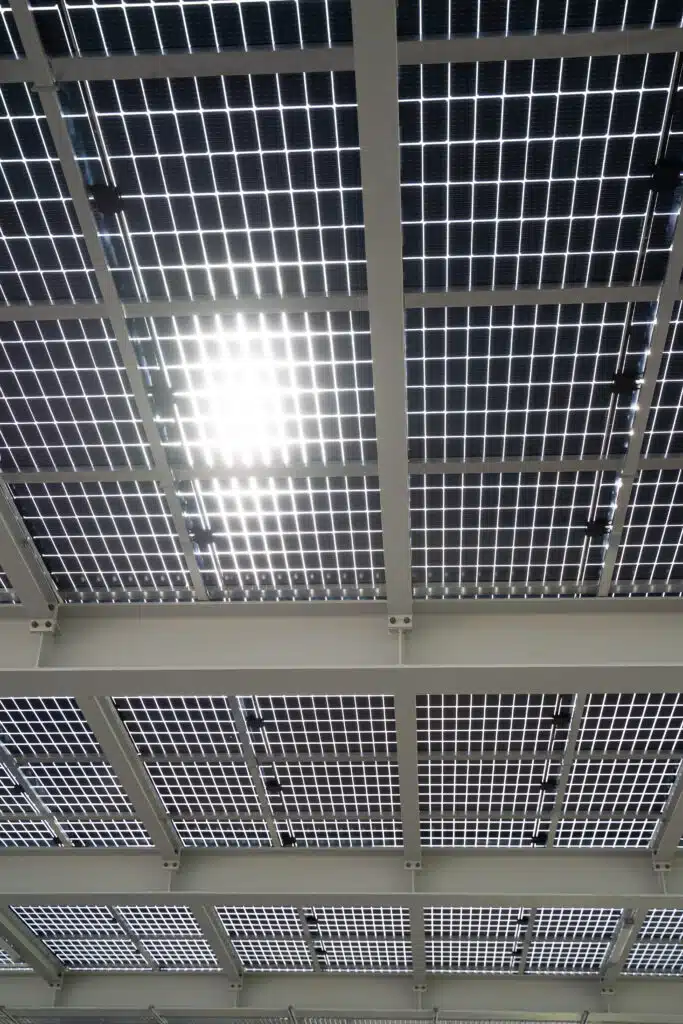
PV system on a commercial roof – what needs to be considered?
- Future requirements: Companies such as logistics firms or retailers should plan for their future energy requirements, for example by purchasing electric fleets or expanding their branches.
- Energiebilanzierung: Der Vergleich des Strombedarfs mit dem möglichen Ertrag der PV-Anlage hilft, die optimale Anlagengröße zu bestimmen.
- Site conditions: The orientation and tilt angle of the PV modules as well as regional radiation data are decisive for the yield.
Optimierung der PV-Anlage & Energiekonzept: Analyse des Energieverbrauchs
Once the above points have been clarified, it’s time for the practical part: a company’s energy consumption should be comprehensively analyzed over a defined period of time. This includes evaluating the load profile, recording electricity consumption at 15-minute intervals and checking the electricity bill.
A particular focus here is on identifying peak loads, as these have a significant influence on the dimensioning of the storage system. If the storage capacity is too small, load peaks cannot be sufficiently absorbed and the expected cost savings will not materialize. Too large a storage system, on the other hand, leads to unnecessarily high investment costs. This brings us back to the starting point: planning is the be-all and end-all.
This necessary information is often available, but it is difficult to analyze. Hierfür bieten professionelle Unternehmen Unterstützung an. Voltfang carries out an analysis of your generators and load profile for you and then determines the economic potential of a battery storage system.
Gewerbespeicher für PV-Anlagen: Welche Kapazität wird benötigt?
Just as important as the dimensioning of the PV system for companies is that of the battery storage system. Overall, technological and legal developments show that there is no general answer to this question. It always depends on the individual case. Depending on the region, grid connection, load profile and generation profile, and especially depending on the application of the storage system, one storage capacity or another is recommended. Grob lassen sich jedoch die folgenden beiden Szenarien unterscheiden:
- Scenario 1 – the battery storage system is linked to a PV system:A rule of thumb can help here: For every 1 kWp of PV generation, the commercial storage system should have 1 kWh of usable capacity. Zum Beispiel: Ein Unternehmen mit einer 250 kWp PV-Anlage wird voraussichtlich eine Speicherkapazität zwischen 250 und 300 kWh wählen, um mindestens den Eigenverbrauch zu maximieren.
- Scenario 2 – There is no commercial PV system:
In this scenario, the capacity of the commercial storage system is determined based on the planned consumption and the available connected load. Only professional advice and analysis is advisable here.
An example from Voltfang shows that this is possible. For a business without its own PV generation and a remaining grid connection capacity of only 63A/≈40 kW, a 300 kW HPC charging station could be realized thanks to the commercial storage system.
Examples from practice
Would you like to see numerical examples of the effect battery storage systems have on the energy efficiency of companies?

Conclusion: For whom are commercial storage systems & PV systems worthwhile?
A commercial storage system is attractive for companies that want to optimize their energy consumption, reduce costs in the long term and operate more sustainably. Companies with high energy requirements in particular – such as production companies, agricultural businesses(see reference example), larger office complexes or charging parks(see reference example) – benefit greatly from this. Battery storage systems help, for example, with the more efficient use of PV-generated energy, reduce high costs caused by peak loads in production or enable the intelligent control of charging stations.
For efficient use with a commercial photovoltaic system, this should deliver roughly 0.8 kWp per 1 MWh of annual consumption in order to provide sufficient surpluses for the storage system. The commercial storage system should then have a capacity of around 1 kWh per 1 kWp of PV power. Doch ein Gewerbespeicher lohnt sich auch ohne eigene PV-Anlage: Er kann dynamische Stromtarife optimal nutzen, indem er Strom gezielt dann speichert, wenn er an der Strombörse günstig ist (mehr erfahren).
In short: commercial storage systems offer flexibility, reduce costs and make companies less dependent on external energy suppliers. Companies that want to reduce their energy costs in the long term and lower their carbon footprint should therefore take advantage of the potential and invest in a photovoltaic system for companies with commercial storage.
Do you want to ensure an efficient energy supply even in winter?
Let’s optimize your strategy together!
Arrange a non-binding consultation appointment today