
Obtain an initial assessment

Logistics & Transport

Typical Energy Challenges in Logistics & Transport

Every site has its own load profile. The charts show a typical pattern and where costs arise.

Projects in Logistics & Transport
Project Type
Application

Typical Use Cases in Logistics & Transport

These use cases are particularly common at logistics sites, used individually or in combination.

Charging station infrastructure
Dynamic electricity prices for companies
Multi-Use Battery Storage
Peak Shaving Battery Storage
Self-consumption optimization

Frequently Asked Questions About Battery Storage in Logistics & Transport

That depends on the goal: For peak shaving, the key factor is power in kW; for utilizing solar power, it is capacity in kWh. The basis is the load profile in 15-minute intervals, along with PV generation and planned charging points. Our projects in logistics and transport range from 540 kWh at Stuttgart Airport and 750 kWh at Teveo in Ansbach to 5 MWh in Greven.

Yes. Fast chargers for electric trucks require several hundred kilowatts for short periods, often more than the grid connection can provide. The storage system supplies these peaks and recharges during quieter periods from the grid or the PV system. This way, the grid connection does not need to be upgraded to the full charging capacity. At Stuttgart Airport, a storage system powers an HPC charger with 300 and 400 kW for electric trucks.

Usually yes, if more solar power is generated at midday than the site needs. The storage system absorbs the surplus and releases it in the evening and at night, instead of feeding it into the grid at low prices. For new systems installed after February 25, 2025, feed-in tariffs are also eliminated during periods of negative wholesale electricity prices (Solar Peak Law). Teveo operates a 750 kWh storage system with 300 kW of power alongside a PV system with 749 kWp in Ansbach.

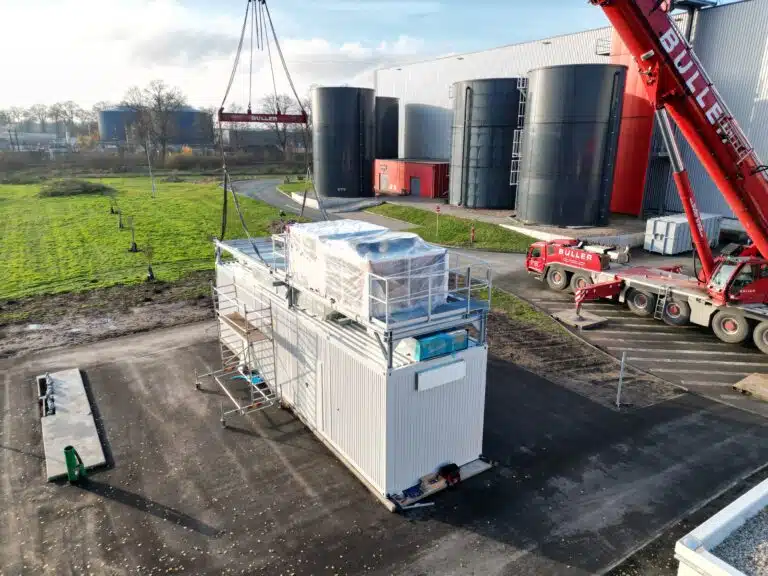
Yes, through so-called multi-use: The storage system first covers the site’s own needs, such as self-consumption and peak shaving. Any available capacity is then used for intraday trading, charging at low prices and selling at high prices. This is particularly worthwhile for larger storage systems. In Greven, a 5 MWh storage system uses the existing 10 kV connection for self-consumption, peak shaving, and intraday trading.

After your inquiry, we request technical data, prepare a quote and plan the project during an on-site visit. After you place the order, we obtain permits, implement the project and support the battery during operation.

For an initial assessment, just a few details are enough: industry, annual electricity consumption, and location. For a profitability calculation, we additionally need your load profile in 15-minute intervals and a current electricity bill. You can obtain the load profile from your grid or metering point operator if you have interval metering. Data on your PV system and planned charging points for the electric fleet are also helpful. If you already know the capacity and power, we can prepare a quote directly.